Payments
How to Set Up a Decentralized Cloud VM with Aleph CLI
Deploy a decentralized VM in 10 minutes with Aleph Cloud's Rust CLI. Install, fund with USDC/ALEPH, launch Ubuntu instances for ~$10/month, and SSH in. No Python, no centralized cloud.
10 min. read -
Aleph Cloud is activating a new tokenomics framework for Aleph v2 that introduces a dual-stream rewards system: a temporary minimum-reward floor for the transition, and a long-term revenue share funded by what customers actually consume on the network.
• Reward floor starts at 900,000 ALEPH per 30-day period and declines linearly over six months.
• 95% of credit payments flow into a distribution pool for operators and stakers; 5% funds protocol development.
• Stakers earn 20% of protocol revenue, with a baseline yield of approximately 4.6% APR in $ALEPH.
• Customer-facing price: $0.011 per Compute Unit per hour, calibrated for 350 CRNs at 70% utilization.
• Quality gate: only CRNs scoring above 80% on Aleph Cloud’s performance system receive workload allocation, and public IPv6 is mandatory.
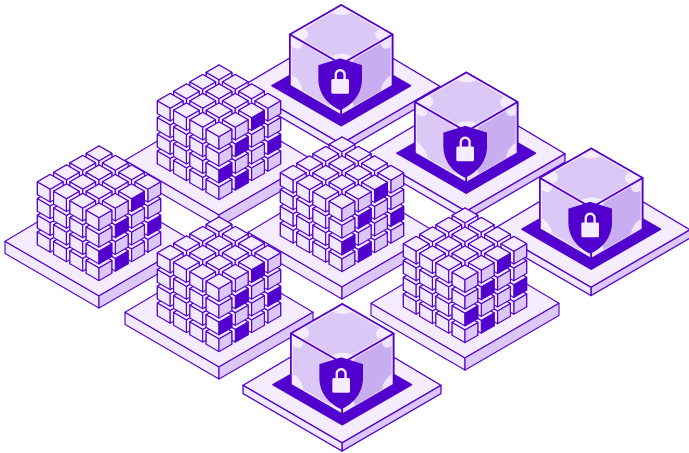
Discover Secure Computing with aleph cloud
Dive into our docs and see how you can deploy AMD SEV-powered CVMs in minutes.
The new Aleph tokenomics framework, activated for Aleph v2, replaces a primarily market-sensitive incentive structure with two complementary reward streams designed to make decentralized cloud rewards less dependent on short-term token-price cycles.
The first stream is a transitional minimum-reward floor for Compute Resource Node (CRN) operators and Core Channel Node (CCN) runners. The second is a usage-based revenue share funded by customer credit payments. Together, the two streams align long-term operator pay with the workloads Aleph Cloud actually serves.
Decentralized Physical Infrastructure Networks (DePIN) grew around a powerful promise: anyone can contribute infrastructure, earn the protocol’s native token, and help build a more open internet. The economics, however, become fragile when infrastructure providers pay for servers, energy, bandwidth, and hardware in fiat currencies while receiving rewards in volatile native tokens.
Academic research on DePIN tokenomics identifies this mismatch as a core provider-economics risk. Token-price declines undermine ROI, discourage infrastructure provision, and create feedback loops where provider exits reduce network quality and demand.
That risk is structural, not behavioral. A token-priced reward stream paid against fiat-priced operating costs is sensitive to the same crypto cycles that decentralized infrastructure networks are meant to outlast. Until a greater share of operator compensation is linked to usage and real customer demand, DePIN networks remain exposed to the volatility of their own incentive assets.
Aleph v2’s tokenomics addresses that loop in two ways.
[Stream 1] A temporary minimum-reward floor
The reward floor starts at 900,000 ALEPH per 30-day period and declines linearly over six months. It gives operators a known transition path while usage-funded revenue ramps up.
[Stream 2] A long-term, usage-based revenue share
Customers pay credits to run workloads. 95% of those credit payments flow into a distribution pool for operators and stakers. The remaining 5% is allocated to protocol development. Stakers receive 20% of protocol revenue. CRN and CCN rewards are increasingly tied to the resources consumed by live workloads, rather than capacity that is merely advertised.
The system is rate-limited by a hard monthly emission ceiling. Rewards can expand with usage, but they cannot inflate without limit. If the cap is reached, rewards are distributed proportionally across eligible nodes. As organic revenue grows, a larger share of operator income is designed to come from real workloads rather than emissions, reducing dependency on token-priced subsidies over time.
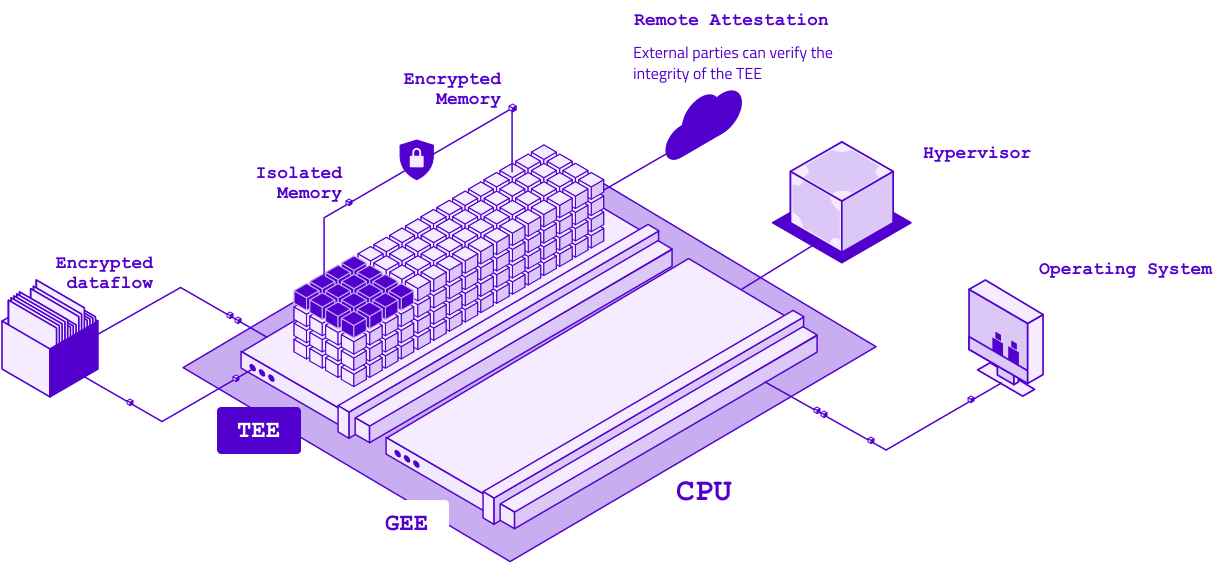
Deploy Your Own Confidential VM
Follow our guide to set up secure, AMD SEV-powered Confidential Virtual Machines and protect your data.
At the network’s design target of 350 CRNs operating at 70% utilization, the model uses a customer-facing price of $0.011 per Compute Unit per hour. The proposal describes a baseline staker yield of approximately 4.6% APR in $ALEPH, with yield designed to grow as organic usage increases.
The new model also introduces harder quality gates:
• Performance threshold: workload allocation is restricted to CRNs scoring above 80% on Aleph Cloud’s performance scoring system.
• Network requirement: public IPv6 is mandatory for nodes hosting instances.
• Specialized capacity: operators of GPU and confidential virtual machine capacity are eligible for higher reward levels, reflecting higher capital costs and stronger demand.
The result is a node economy designed to pay for capacity that is used, not capacity that is only advertised.
The redesign depends on a corresponding demand-side overhaul. Aleph Cloud’s tokenomics proposal describes a credits-based payment system where users can pay with USDC, ETH, or $ALEPH via credits. Aleph Cloud’s 2025 review described the credit system as part of a broader shift away from incentive-pool-funded node rewards toward a self-supporting economy where nodes are paid by revenue generated from actual usage.
For developers and enterprises, the practical effect is meaningful. Workloads can be paid through a predictable credit model rather than requiring teams to acquire or hold $ALEPH before deploying. $ALEPH remains a first-class payment option, but it is no longer the only path into the platform.
The thesis embedded in Aleph Cloud’s redesign is portable. DePIN networks, whether focused on compute, storage, bandwidth, or other infrastructure categories, face the same fundamental tension. Supply must be bootstrapped before demand is mature, but long-term economics must eventually be funded by usage rather than emissions. Academic research identifies non-speculative demand, stable user pricing, provider ROI, and governance-calibrated issuance as central design challenges for DePIN tokenomics.
That shift is already part of the wider crypto conversation. Public discussion around DePIN increasingly distinguishes infrastructure rewards driven by actual usage of bandwidth, compute, and storage from incentive models based primarily on token emissions.
Aleph Cloud is putting that transition into production. By combining a temporary transition mechanism, usage-funded rewards, transparent quality gates, and credit-based payments, Aleph v2 aims to create a node economy where infrastructure pay reflects work performed, not market sentiment alone.
Ready to Build Securely?
Implement Confidential Virtual Machines today and lead the way in privacy-first computing.
Payments
Deploy a decentralized VM in 10 minutes with Aleph Cloud's Rust CLI. Install, fund with USDC/ALEPH, launch Ubuntu instances for ~$10/month, and SSH in. No Python, no centralized cloud.
Computing
Aleph tokenomics introduces a dual-stream rewards model for decentralized cloud operators: a transitional reward floor plus a usage-based revenue share.
Payments
Pay As You Go and Holder Tier payments are officially deprecated. Aleph Cloud now runs on a single credit system. Top up with USDC, fiat, or ALEPH and pay for what you use.
Virtual Machines
Explore how OpenClaw AI agents, and Aleph Cloud’s decentralized AI Supercloud are redefining autonomous computing with sovereign, censorship-resistant infrastructure.